„Predicted impacts of rising carbon dioxide and temperature in Europe at stand scale“
(ENCVY-CT95-0077, 1996–1999)

„The likely impact of rising CO2 and temperature on European forests“
(EV5V-CT92-0127, 1993–1995)

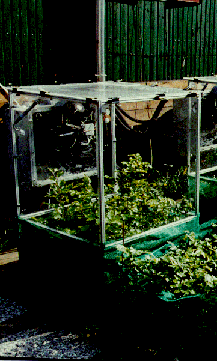
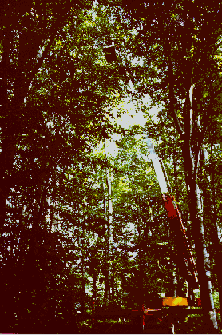
Over the past 130 years since the beginning of the industrial
revolution the amount of carbon dioxide in the atmosphere has been
increasing as a result of the use we have been making of fossil
fuels - coal, oil and gas. The concentration has risen from ca 270
µmol mol-1 (parts per million) to 365 µmol
mol-1 and is continuing to rise at an increasing rate
which is at present about 1.5 µmol mol-1 per year.
With the current increasing use of fossil fuels, it is estimated
that the concentration will reach 700 µmol mol-1
by the middle of the 21st Century. Atmospheric carbon dioxide is
the basic substrate of photosynthesis by plants which absorb carbon
dioxide from the air around to grow. This investigation has been
concerned with evaluating the effects of the increase in atmospheric
carbon dioxide concentration from the present value to the expected,
future value of 700 µmol mol-1 in the next century
on the growth and physiology of young trees. The responses of trees
are of particular significance in this regard because the forests
of the world contribute in an effective way at the present time
to the removal of carbon dioxide from the atmosphere, the storage
of carbon in wood and its transfer to the soil.
The ECOCRAFT project has been in progress since 1991, first in EPOCH,
then in Framework III and now in Framework IV. In these three programmes
there have been approximately 12 Partners throughout and they are
listed at the end. The main aim of the project in Framework IV has
been to test the hypothesis that a doubling of the global atmospheric
CO2 concentration, and associated, more local changes
in climate predicted from General Circulation Models (GCMs) to occur
across Europe over the next 100 years, will not be detrimental to
European forests. The subsidiary hypotheses to be tested are as
follows:
- impacts of elevated CO2 and temperature will be limited
by availability of nitrogen in northern temperate and boreal forests
and by availability of water in Mediterranean forests, and
- a delicate balance between gains of carbon by CO2 assimilation
and losses by tree respiration and microbial oxidation of soil organic
matter determine carbon sequestration in stands and may be tipped
one way or the other by rising CO2 and temperature.
Partner
- Prof. P.G. Jarvis, IERM, University of Edinburgh, UK
- Prof. B. Saugier, Université de Paris-Sud, FRANCE
- Dr. M.B. Murray, ITE, Penicuik, UK
- Prof. G. Scarascia-Mugnozza, University of Tuscia, ITALY
- Dr. P. Freer-Smith, Forest Research Station, Farnham, UK
- Dr. Eric Laitat, Université de Gembloux, BELGIUM
- Prof. R. Ceulemans, University of Antwerpen, BELGIUM
- Prof. S. Linder, Swedish University, Uppsala, SWEDEN
- Prof. S. Kellomäki, University of Joensuu, FINLAND
- Prof. R. McMurtrie, UNSW, AUSTRALIA
- Prof. M. Marek, Academy of Sciences, CZECH REPUBLIC
Stand: 06.07.2005
Autor: Manfred.Forstreuter@fu-berlin.de |
Haftungsausschluss